
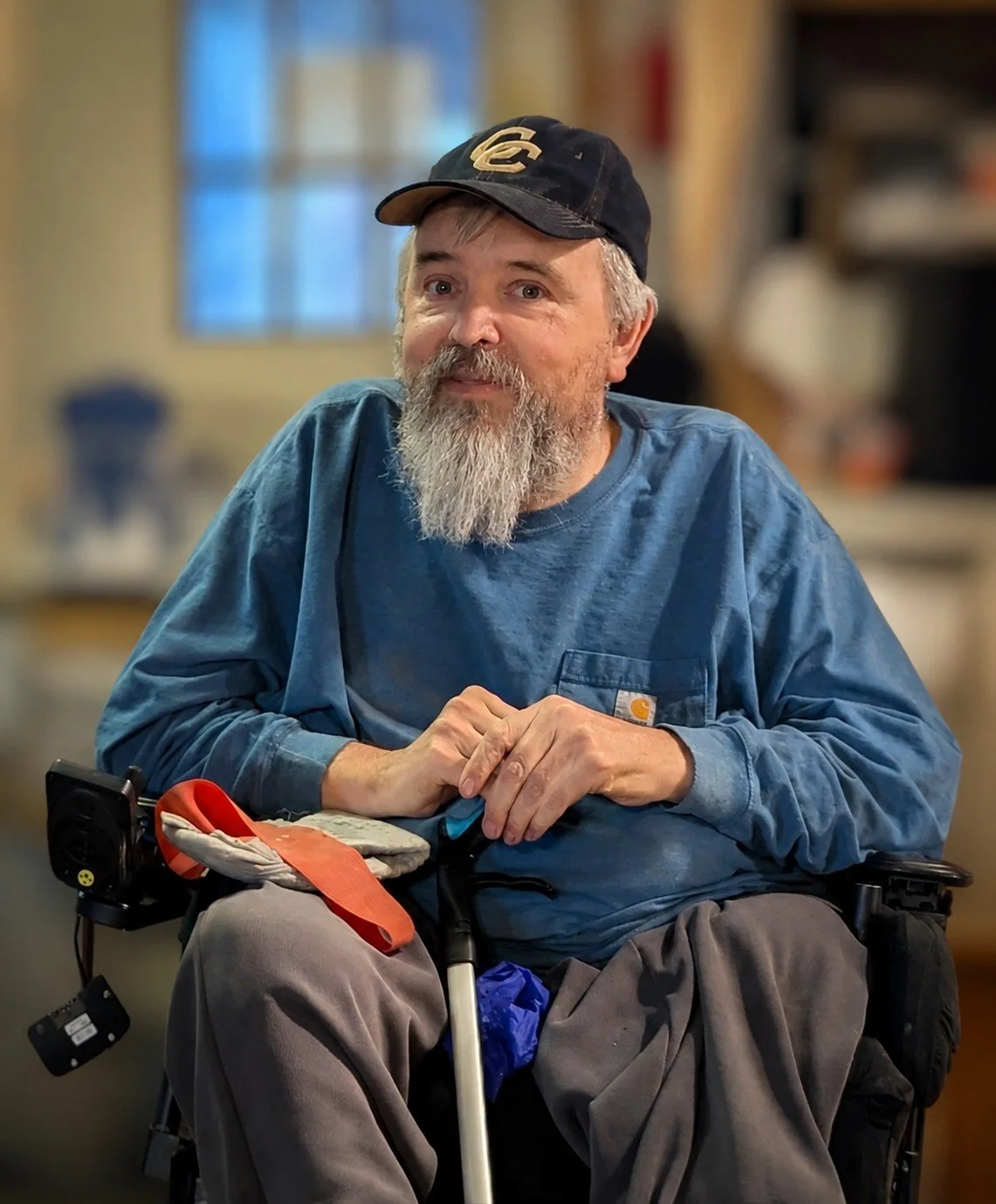
FACES OF PERSEVERANCE
Name: Jonathan Symonds
Age: 60
Residence: Washington
Level of Injury: T-6 Paraplegic
Occupation: Principal
Date of Interview: June 17, 2026
1. First, if we could do an introduction. If you could introduce yourself and tell me a little bit
about your story, as much or as little as you'd like to share.
My name is John Symonds. I was a middle school principal. Before that, I was a middle school
teacher. In 2012, on Christmas Day, I was paralyzed in a snowmobile accident. I went over the
handlebars of my snowmobile, and it broke my back and in several places. T6, my spinal
column was crushed, and I’ve been paralyzed from thoracic six, ever since. When I initially tried
to go back to work, um, I guess I should back up. When I was released from the hospital, I had
a small tear on my backside, in the skin. Before I went home, I was sent to a nursing home, and
the tear had become very infected, unbeknownst to me. When I did go home, the home health
nurse saw me that day and said I was going back to the hospital because I had such a bad
infection. It had become septic, and they did surgery on it that day. Then, I stayed in the hospital
another week, and then I finally got to go home. But ever since that day, I guess, I've been
having issues. I just get them (pressure sores) where I would get them healed, and then
something else would happen. Last time, I wasn't paying attention, and I was sitting on a towel,
without knowing that I was sitting on a towel, in my chair. I went through the day, and ended up
with another pressure sore. Ever since then, I've been dealing with battling pressure sores.
2. How has Bonus Years supported you?
My story, that, this last year, I was able to get a bed through Wes (Wes Price, Founder of Bonus
Years). Hopefully, this bed is going to help with the healing of the pressure sore. Once you’ve
had a pressure sore, you are very susceptible to skin tears and skin issues for the rest of your
life. This bed will help.
3. What does this bed do compared to the average bed?
What this bed will do is it will automatically roll me from side to side, taking pressure off that
area every 20 minutes and hopefully, I'll see significant progress. I have to stay in bed a lot still,
which isn't always easy. But I'm trying very hard to follow that regime.
4. How is the bed controlled?
It’s a preset program, that when they came and installed the bed, that they did the programing of
it so I didn’t have to. The caretaker programs it or can program it. Now, I do have a remote
control that I can turn it off and on. So like if I need to sit up or if I need to do something, I'm able
to do that. So it's easy enough for that to be used.
5. Is there anything that you would change about it that you'd like to have it improved with,
or different qualities that you have found useful?
If it was a little bit wider. I'm a big guy. But I've learned to adjust the narrowness of the bed.
That's about the biggest thing I'd like to see. But, you know, beggars can't be choosers, and I
feel very blessed to have it.
6. Has it made life easier for you or your caretaker in any way?
It's made where I don't have to worry about trying to roll, trying to move myself, and my wife
works hard at her job. She's my caretaker. She doesn't have to worry if I’m not being rolled or,
or, you know, rolling, or I’m rolling myself. Because I'm not very good… I wasn't very good at
that. This bed makes you stay up on a side.
7. What is the most challenging part of living with a spinal cord injury?
Besides the fact that you can't walk, you can't get up and go get a drink of water, you can't get
up and move around, like you used to. I can accept that. It's the pressure sores. It's the other
issues that come with it, too, that make it very difficult. It's the incontinence, it's the, yeah, it's
everything else.
8. Could you tell me a little bit about what you did before your spinal cord injury?
Well, before my spinal cord injury, I golfed a lot. I loved to go fishing and boating and I could do
that basically by myself. I love to snowmobile. I like to ski. I was very active. I mowed my own
lawn and took care of my garden and so I felt like I was fairly active before my injury. You know I
was working as a principal and, then it just so happened that after that first year, in 2013, the
district planned on consolidating the middle school with the high school. I was able to continue
working for a short while. I did work in their alternative school, um, as a principal. But health
reasons pretty much caused me to have to retire, because I just couldn't continue to go to work.
I just couldn’t. I was always getting this pressure sore that was becoming, that's getting septic,
et cetera.
9. What do you wish people and others would know about spinal cord injury survivors?
Well, I wish people would continue to ask me to do things or come up and visit me or…
everyone says, yeah, call me up and we'll go do this and they never do. I have a couple of
friends that, that I still do things with, but not very, still not very much. But they at least take the
time to come see me or, or I go see them, whatever. One of them actually built a ramp into his
house.
10. What are some of the things that you do despite your spinal cord injury?
Activity wise, I have friends that live in Seattle and they'll come over to Spokane to a friend of
mine's house and we'll go up and I'll visit them for a day. It used to be, I'd go up and visit for the
weekend and we'd go and do whatever. And, uh, but now it's, I'm not able to spend the night or
anything like that because it's just too difficult.
11. Would you be comfortable sharing some of your testimony?
JYou know I believe, God doesn't give you anything that you, He doesn't feel you can handle and
that, you know. There is a reason behind everything and it's not always easy to stay strong in
the faith, but, you know, it's, there are things out there that help renew your faith. Being able to
get this bed. I feel blessed that Wes was able to get that for me.
12. What are factors that motivate you to keep going and not give up?
Well, I try to keep going because it's what you should do. You know, my wife, my family. I really
hope someday that my wife and I will be able to travel. We have a couple of kids we have in
Germany. Well, they're not our natural kids. They are our foreign exchange students that lived
with us. One of them was with me when I had my accident. He just came with his girlfriend for a
visit. It was great to see him. But, you know, those things. And I feel like eventually I will be able
to go fishing in my boat, maybe, rope somebody into it, that likes to do it as much as I do, and is
willing to help me get in the boat.
13. Do you have a special chair that you use?
I have two chairs. I have a manual chair and a power chair. My manual chair is what I use to get
in. I had a friend of mine, who was actually one of my former students, who runs a, uh, he works
on vehicles and he owns a shop that makes wheelchair vehicles for people. He works on them
and he put a lift on my boat that can lift me up and put me in the boat and then I will sit in my
chair, sit in my manual chair while in the boat. We also have a pontoon boat, which has a ramp
that I get in it. But my wife has informed me that it's always informed me that that was her boat
and I have a fishing boat. I bought it two years before my accident with the knowledge that it
was my retirement boat. My goal was for retirement, was I wanted to be in a place where I could
golf and I could fish. And I was a duffer. I just liked to go out and hit and it was one of those
things in sports that, you know, a few shots, would keep you coming back every time because
you’d always hope that you’d keep doing that. But I got to pretty, I was pretty good with my irons
and, I just could never, I needed to get lessons and I would probably eventually gone back and
gotten lessons.
14. What would you say to someone who's recently gone through a spinal cord injury?
Life isn't over. It's begun a new chapter and you have to keep the faith and I would pick an
activity. If you can be around people that want to work with you. If you lived in Spokane, I know
they have activities that are very well geared to people in wheelchairs. And what is it called,
quad rugby? That I went to watch one time and was like, wow, that was amazing. They have
special wheelchairs for it because they run into each other, at high rates of speed, and they
would get broken feet if they didn't have these. These wheelchairs have bars around the base,
so your feet aren't protruding. And they still obviously they have some disability, but they can,
they can, you know, move their own wheelchair. I know Wes is, you know, he, for him, he
couldn’t. He can't do it cause he's in the power chair, but these people are, can use it in a, a
manual chair and they're able to. They fly around that and I see people hit the floor. I'm just
going, my gosh, it's like they have no fear. I was sitting in there, in my power chair going,
“look, I don't have a chair like that. I'm just watching.” There were some younger kids there that seemed
to be a little zealous. You know, and they have wheelchair basketball where you know it wasn't
as easy. I found, I loved to play basketball when I was younger. We played all the way through,
uh, when I was a teacher, um, I was playing all the time. Tell people they need to find activities,
an activity and then expand on it. And there are people around them, who might be able to give
suggestions for something they never, ever thought about. And there are people out there that
will, will help them do something, you know, do that.
15. Why is it useful for SCI survivors to have a community like Bonus Years or attend Bonus Year meetings
I think to learn something new or, you know, I guess the other part of it is, meeting people that
are in similar, or you see some people that are worse situations than you are, or whatever, and
how they're dealing with it. I think those are positive things that come from those meetings too.
Well I was curious on something I heard. One guy was saying how he used a rose. What was it
Rose hemp, Rose… anyways, the oil he said he had that it helped. They would put on his
wound and it would help the wounds heal. I asked about that, at my wound care place, and they
said, well, it probably helped kept it moist if that was what they needed, but my wounds weep an
awful lot. You know, when you're, when you're a paraplegic, you, you’ve been around several
people that are quadriplegic and, uh, including Wes. I admire him and how he's, he just is a
go-getter, and, you know, he's just, he's not going to let anything stand in his way, and I admire
that. I have a friend of mine that is a quad, uh, and at a similar level as Wes, cause he also has
a tube that he blows into to move. He's part of a foundation that helps other people that are
paralyzed. He has a good foundation of people that surround him. He was paralyzed when he
was 16. His family is well thought of, and so there were a lot of people that made sure that he
wasn't left out.
16. What are some suggestions would you have to someone who has a family and has a
spinal cord injury? What are some pieces of advice you would give in that field?
Get the resources, find where they’re at. Any resources that are available to help them. If you
are able to get help at home and help at all. I know it's hard for my wife to have to take
everything on. You know, she’s stuck with me, but that wasn't something either one of us had
bargained for when we got married, it was something that happened and we've both dealt with it
the best we can. But it's a lot of, it's a lot of pressure on, I feel like it's a lot of pressure on her.
Like when I have incontinence issues, you know, I need help changing sheets or doing
whatever. I wish I could control those things, but those aren't things I can.
17. What are some good resources that you've found?
A good resource is Wes (Wes Price). I had an OT (occupational therapist) that used to come
and she was a great resource to help do things. You know, my doctor, my spinal cord doctor,
you know, she's making sure that I get the right equipment to help me out. I know St. Luke's in
Spokane has resources for people that live closer and are able to utilize.
18. Is there a community you're a part of, or is it important that spinal cord survivors obtain
and retain community?
I think so. Because within that community, you'll find people that will, that will reach out and help
you. But like I said, uh, sometimes, finding that community, uh, it disappears, so you have to find
another one, and it isn't easy. I have a van I’m able to drive. I’m able to transport myself. People
see me, and they figure that everything's all good. You know, I'm going out to the store and I'm
shopping. So they see that and think that, wow, I'm doing great. Like I said, I like to go fishing. I
like to go hunting. I would like to do some hunting. I haven't, it's become harder and harder to
go, because, when it comes to that time of year, I can't get anyone that I know that would come.
We have a small farm with animals and to find someone that would come and feed the animals,
no one wants to do it. So you can never, we never are able to leave. I'm hoping to make it to a
friend of mine's retirement party back where I used to work, in Bridgeport. And it's not until
September, but I just don't know if I'll be able to make it there.
19. Would you have any suggestions or pointers to caretakers or nurses and how to provide
better care for spinal cord injury survivors?
Yeah, just remember they're human. Keep doing stuff with them. I guess that's the biggest thing
is just always keep in mind that they're human beings and that they can do. You'd be surprised
at what they can do and help them reach their potential, their full potential at what they're
capable of doing. I'm a very social person. I like to visit with people and talk and being by myself
all the time isn't always easy, but I get it. You know, that's where I'm at right now. I enjoy getting
people to come and visit.