
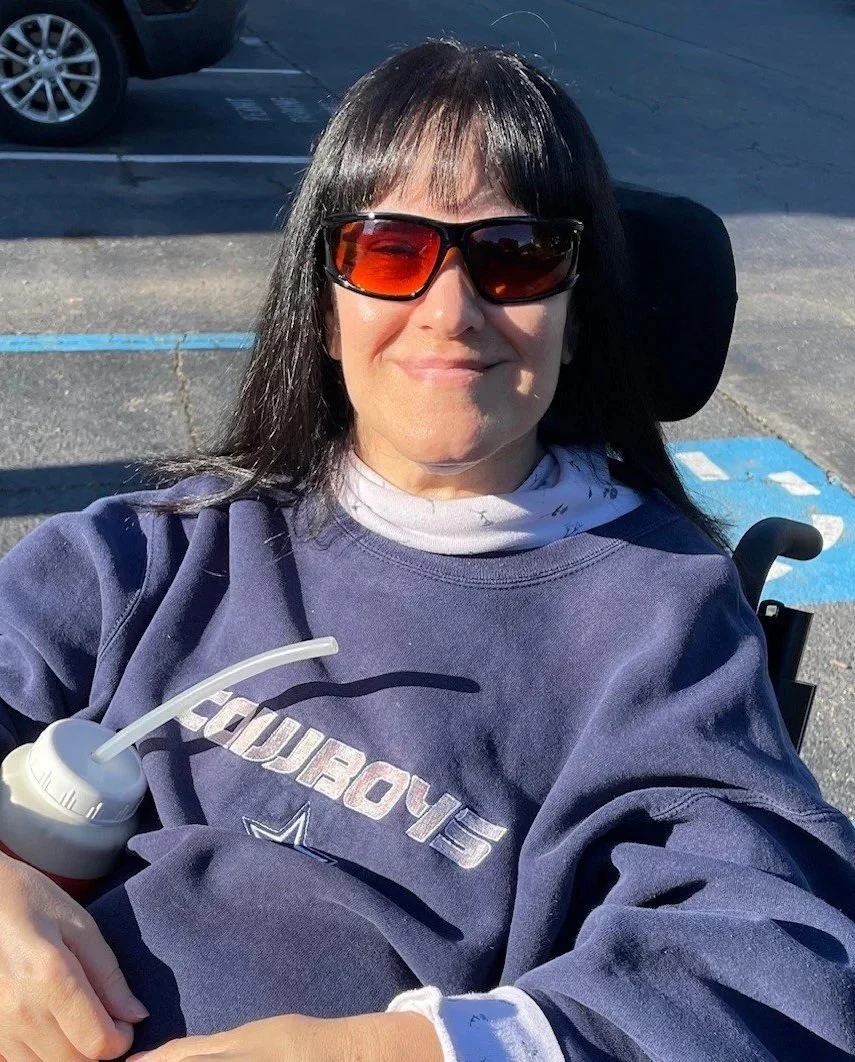
FACES OF PERSEVERANCE
Name: Joy Crawford
Age: 58
Residence: Virginia
Level of Injury: C5-C6 Quadriplegic
Date of Interview: June 19, 2026
1. So the first question is, can you tell me about your story and how you grew up, your accident, and then what you're doing now?
Oh, let me tell you, I'm Joy Crawford from Virginia Beach, Virginia, and I was in a car accident about 40 years ago. It'll be 40 years July 22nd, next month. I was only 17, just graduated high school, was on vacation in Virginia. I'm originally from upstate New York. And I was on vacation and I ended up, like I said, in a car accident and it was my first car accident. And it ended up breaking my neck and paralyzing me at two, five, and six, quadriplegic. And it was just at the time, my mom and my two brothers. So, it was a little hard on her being a single mom and everything and to try to care for and deal with this new life reality and everything. It was a little bit of a rough go because at that age, you're just like, what is going on in my life, and this is a completely new thing. I went from almost 18 to kind of, a lot of people think, oh, you're 18 and you start, I guess, to live your life in different ways or whatever ways that person, individual wants or chooses. Before that, I had been working, graduated from high school, I was set up to go to community college for a couple of years for accounting. Yah I was driving, I had my own car and everything and the next thing I know, all that was just gone. I was set up for a job for the summer before school and everything and all that just went away, and it was a real, I don't know how to explain, a real wake up or call or… but that was just a reality, you know with all that happening. It took me probably some years to really grasp everything, but like I said, it's been almost 40, so I've grasped it since then. So, I ended up, because my mom is a single mom, she was trying to work and help take care of me. Where I lived in upstate New York, it wasn't a lot of nurses or caregivers and things like that. So reluctantly, my mom, she had to put me in a nursing home even though she didn't wanna do that and I didn’t. But even though it was hard, it ended up actually helping me to be a little more independent, believe it or not. I know that there was a time when I first got in there that I just was like, here I am 19 years old and in a nursing home, like what in the world? You know, I'm seeing things and hearing stuff. You know, the surroundings was like, here I am completely in my right mind and I'm on a floor for younger people and it's like, wow, like what world is this? But I made a decision, I don't know at what point, to say I'm either gonna make the best of this and make it a more positive than a negative thing because at the time I didn't know how long I was gonna be in there for. I just decided I just have to adapt and adjust and be positive. So I just went around, it was in my manual chair and went around and to just talk to other people who I could talk to and maybe lift them up or help them in whatever way I could help them and just kind of turn it into that kind of experience.
I was in the nursing home for a year and a half and I was talking to my mother about how to go into rehab again. So a rehab place, my mother had got a scholarship to stay for three months, you know, where it was paid for down in the Western part of Virginia. So, after a year and a half, my mother, my brothers and I, we moved to Western part of Virginia. My mother gave up her job that she loved, health insurance, everything for me to get out of the nursing home and to go to rehab. Then kind of moving back there, we moved to Virginia Beach, Virginia, where I currently reside. It was such a nice sacrifice that she did for me to do that. So I went from the rehab to a nursing home just for like a month while my mother got things straight and set up for me to come home and everything. But I was only home like a week and a half and my mother passed away unexpectedly at the age of 50 from a massive heart attack and that really uprooted our lives because she was the glue and you know the main parent that was in our lives. So I didn't really get a chance to really do anything at that time because I only been back at home for a week and a half. So I had to deal with that and her funeral and death and everything. I became like a surrogate mother to my brothers and because we were really close with our mother and she was just everything in our world, to be honest with you. My brothers had especially even a harder time than I did. So instead of putting myself first, I had to put off going to college, with the funeral, et cetera, et cetera, and being there for my brothers. I finally was able to make it to that spring semester and I was going for, I think, accounting, and at that time, even though originally a few years ago, that's what I was planning on before my accident. For some reason of the same interest, you know, in it. So, but there were a lot of challenges, this was 1989 and there was a lot of challenges as far as disability related, with school and everything. So, I only took like, I only went like, I think, a few semesters to a community college down here. And I was really discouraged because one of my classes involved me being able to physically cook something. The teacher told me that I had to be able to cook something in order…something with the class, or to pass something, I don't remember exactly. So I really felt like I, you know, like I was defeated. I just felt like I'm not gonna be able to do this. So I just stopped going. I think at that point, I had wanted to do something like with like a registered dietitian or something, health related and, but I gave up with that. There was just a lot of challenges in there. You know, it didn't feel the support. You know, it wasn't like now, because then the ADA (American Disabilities Act) was only since 1990. This was the spring of 90. So, I don't think at that point that the ADA had even happened yet. So it was a little discouraging, but I knew I had given it a try. Then I got involved, and was in a relationship. That's kind of hard to maintain, you know, relationship, going to school, and then, you know, just feeling like you're a little on the defeated side. There's a place called the Endependent Center where I live at now. That at the time, I didn't really understand how they advocated for people with disabilities, stuff like that. So now, of course, since then, I have learned a whole lot more. But at the time, I just really, I think I just gave up and felt defeated. So I really became more like there for my brothers and really put in kind of other people first, my brothers, my relationship, and I just kind of put me and myself to the side for years. And actually, that's what I pretty much have done. Then I broke up with my boyfriend at the time, without really trying or even thinking about another relationship, I just ended up in another relationship and it had its pros and cons. So trying to go back to school, I never completely gave up, but it just that relationships are hard to do, and go to school, and have a disability. So it was just a little too much trying to still be there for my brothers and a relationship, and again, I just put myself last on that. I never really ended up going back to school. I did try volunteering for the independent center, like to do data entry. And I really wanted to volunteer, but I had to stop doing that because I didn't want to commit to something and then not go through with it. So I've just really been there more for other people throughout the years, especially my brothers though, and this relationship that I still am in 34 years later. Sometimes something's got to give, it's hard to do all. Whether you're a mother full-time or you're working or you're married or a relationship, something's got to give. I'll mostly be there, you know, for people if they've gone through something, they call me.
It's like, I've been like a counselor, something to people without doing this for any kind of living or any schooling. You know, people will call me up and, you know, they would talk about what they're going through and everything. Even though I have the disability that I do, they didn't seem to be phased by that, and I didn't focus on that and go, “I can't talk to you because I have a disability”. You know, I never let that get in the way of helping somebody when they were, whether it was my brother, you know, after he lost our mother and his father and he didn't want to live or just anybody. I've just been there. So it's not like I haven't done anything, cause I will tell you, listening with people that are going through their issues or problems and either talking them off the edge or ledge or trying to encourage them. That's a lot more work than people realize. And I still do that today, you know, people will call me or my brothers will call me and, and they'll say, thank you for listening or thank you for being there. So maybe I didn't go the route that I wanted to. Maybe this is what God wanted me to do because I sure did try. You know, I've been there for a lot of people, for caregivers, that even though they're coming in to help me, you know, they maybe have issues. And I've tried to be a positive influence to do that, you know, with them and tell them about God. You know, after I got saved in 1994, even though I had a Christian mother, but when I actually, you know, got saved and gave my life to the Lord in 1994, I just encouraged people spiritually and otherwise and be there for them. They needed somebody to talk to or be encouraged. You know, here I am almost celebrating 40 years next month, and there's been a lot of ups and downs and things that have happened, but by the grace of God, I've made it this far. But I give God all the credit because there's no way I could have made it this far without Him, because you can have 20 people around you or one, but if you don't have God and don't rely on Him, it doesn't matter. You still, at the end of the day, people are people and they're not always gonna be there or they may fail you because they're human beings. So at the end of the day, I know that God is not going to, and He's the one that's giving me the strength and help to make it this far, whether I've had 20 people or one, around me or when I was in a nursing home. My mother being a Christian woman and instilling that encouragement and positivity in me, she didn't believe in chance or negativity, and she had a really not an easy life of her 50 short years. So I give God all the credit and He's put people across my path, good, bad, and otherwise, that have helped me to get this far. So, but you can ask me, I'm sorry, I'm good.
2. No, you're good. I'm just soaking it all in. That is an incredible story. Yeah, you’re kind of leading into it. I would love to hear your testimony and how you met Jesus.
Well, that's a good story. Now, mind you, my mother was a Christian. I do believe that eight years old, I got saved, but I went my own way and off my own path. But my mother, thank God, she was a godly woman and a constant in my life, regardless, she loved me, whatever. So she showed me a good example, even though I didn't appreciate it. I think the fall or October of 94, I was just having a lot of issues in my relationship and just dealing with that and the disability and just a lot of different things and just not being able to, I guess, always do what I want when I want and having, you know, those physical limitations at times that being real with it. So I felt like I was at my wit's end to be honest with you. I had never watched anything, any TV in the morning time, but I had the remote control near me, and I happened to hit it. I don't know how, but you could hit any button, but I happened to hit it where it turned on and Gloria Copeland, she's a Christian woman. But at that time, the TV went on, the channel went on, she was preaching about patience and so instead of turning the TV off, I just started listening to her. And that was the beginning, that was a lifesaving moment, because other programming and teachers and preachers on that same channel that came on before and after her. And I was going to start with Gloria Copeland and just listen to her about patience and God and all that. I don't remember that exact period of time, but it was not a long period of time after that, that I gave my life to the Lord and surrendered that and asked for help. Because, you know, a lot of times it seems like we're at the… we’re at the wits-end and that's the end of our rope, when we say, all right, you know now, go to God, and we ask for help. But nonetheless, at least it happened and… I just started listening a lot, you know, before then I didn't have a lot of interest in, you know, God like that or the Bible. But after I started listening and watching her and other female, male teachers, preachers, I just had an interest after I got saved especially. That was a real help to me more than I realized because I just, I knew that something had to happen. I mean, it's not anything spectacular, but it was fascinating to me because I. If I didn't have, whatever happened with that remote control that made me hit that just the right way to turn it off, just that right channel was her, speaking about something I needed, because you definitely need patience, you know, when you're dealing with human beings. So I was like, well, that was divine. I knew that was God answering my prayer and saying, you know what, I'm here. Even though I didn't make time for Him, until then, I thank God that He made time for me and showed Himself. So that is what's helped me, and even though it's been really hard and challenging, at times, not all the time, but at times, doesn't matter what it is, disability or relationships. Like I said, I've made it this far only by His grace and mercy. So, yep, that is my story on that, and if I didn't give my life to the Lord and didn't trust in Him and seek Him and listen and let His word just help me. There's just no way I… you just, you can't make it in life. There’s too much that goes on, and we can only have so much control over things. When you lose a lot of control, you know, like I did with my accident. You realize as human beings, we really don't have as much control as we think we do, but a lot of times it takes something happening for us to realize that.Absolutely. My goodness. It's those things in life that we know aren't coincidences that I think are truly powerful in bringing us to God.Oh, true. That was no coincidence, absolutely not. Do you have a favorite Bible verse or quote that motivates you and kind of keeps you going? And along with that, what are other factors in your life that really keep you from wanting to give up? There's a couple of scripture, I know, “I can do all things through Christ who strengthens me” (Philippians 4:13), and “With God, all things are possible” (Matthew 19:26). So yah those two are the main ones. I mean, I've thought about at times giving up and, it never really went anywhere than just the thoughts of it. I maybe even cried an ocean of tears and stuff like that, but two things have helped me. The fact that my mother gave up so much for me to get out of the nursing home and go to rehab. That's helped me from giving up as well as, I'm only here for a certain period of time alive on this earth anyhow. So, you know, I just might as well make the best of it, even though I've had those times where I just felt like, oh my goodness, I just can't do this. You know, my fiancé crossed my path and certain other people and so I just look at it that I'm here when a lot of other people, for whatever reason, younger than me, older, and all ages in between are not here. So I've just realized over the years that even though I felt that way, and sometimes I still may have that, or it may pop in my head, I never truly, you know, went a hundred percent with it, but I may have thought it, felt it, cried or just whatever the case, but God has just helped me through it and got me through it. And it's just amazing how He's given me the strength, even though I know I don't have any, but He's enabled me to do what I know without His help, I couldn't have done.
3. So my next question then would be if you could tell your younger self, the one that just got in the accident, or someone who's just recently experienced a spinal cord injury, what would you say or how would you encourage them?
It's funny you say that, I forgot to say that, one of the things that I have wanted to do over the years that I haven't done is actually talk to or meet people that are newly either spinal cord injured especially, because I know that happened with me. I think I probably would tell my younger self your family is first, your mother and your brothers, be there for them, and give your life to the Lord now. Your family and God are priorities. And that's actually what I’d tell my younger self, like just stop what you're doing, be there for your family, give your life to the Lord, and then everything else is just, that's the level of importance. Yeah, and somebody that's newly spinal cord injured, I think I would just tell them, it's gonna be challenging, it may not be easy, but don't give up and just tell them put your trust in your life in God's hands and He will enable you and help you and give you the strength, and just the ability to deal with this new life and this disability that now is a part of your life.
4. What are some helpful tips and tricks you've learned through the years or communities you've been a part of that you could provide as a resource for people who have recently undergone a spinal cord injury or just searching for some help?
Well Independence Center has been a help to me as far as to, you know, help to live as independent, you know, as possible. So the Endependence Center (https://endependence.org/), I can say, you know, in the community. if in your community, because I don't know how the Endependence Center, as far as their reaches goes in each state, but I do know that a lot of states and cities in those states have some kind of maybe organization or something that either advocates for people with disabilities or can help. So I say that first, because everybody's needs are different dependent on disability, et cetera. But if it's spinal cord injuries, yeah, especially. As far as the level of care, it kind of just depends. But I would reach out to the Endependence Center as a main thing for that, because that encompasses a lot of things. The more support that you have, the better. So I would say that any organization that can help you in that way to be independently. Whether you can live independently on your own, in whatever way, shape, or form that is, that would be ideal. But support is really important and help with care or just anything. Mentally, physically, it's just important to be around that and if you can surround yourself with that to help in whatever way that, you know, somebody needs, you know, help and support. Well, I know one of the things that really did help me, and this is part of the support community, whatever, that my mother, it was really hard after disability, my mother, she had this thing where giving up just wasn’t an option and she lived it. She was a really positive example. So that really helped me. The people that are like depressed, I feel for them because I understand, but my mother really instilled this can-do positive and she gave up so much for me and that's one of the things that helped me get through when I did want to give up. So I feel for them because the more positive, Christian, godly people you have across the path, you're much better. If you're feeling depressed, try to reach out to, you know, going to church and getting that support. A church that you might think that, you know, is what you're looking for because everybody, you know, might be different on that.
5. What are some things that you've done in spite or despite of your injury?
My fiancé took me to Disneyland, when I probably wouldn't have never made it, but we drove down there. Mind you, this is back in 1997. And so, you know, we drove down there, drove us down there, me and a caregiver at the time, and we had a good time. We were there for about almost a couple weeks, I think a week and a half. And I've been on the monorail and certain other rides, even in my power chair that I didn't think I'd be able to get into. So it's possible. You know, what I've learned about the human spirit over the years is when people really, really want to do something, you get resourceful and you find a way, you get determined to do that. It's really about your determination if you really want to do it, and also trusting God and saying, God, you know, I want to do this. Make a way, you know, for me to be able to do that. He will do that and enable you. But I understand what it feels like when you feel like it's not a possibility. But a lot of it starts in your mind, in your mindset, and if your mindset and your mind are right, even when you have those rough days and those discouraging days and those days you feel like, I just can't deal with this another day. But if your mindset is trusting God, you can bounce back from that and you can do whatever you set your mind to, if you want to, really bad. Now, mind you, I never had that great desire to do a lot of these things despite my injury. But I know of people and I've seen, you know, people like on TV and their testimonies of doing that. And I have great admiration, but sometimes just the simple fact of making it through each day and with a disability, you can do these things. They're possible. But if my fiancé didn't say, hey, you know, I'd like to take you to Disney World, I probably wouldn't have thought that it was a possibility or thought about it. But, you know, I got on the phone and I called and asked about handicap accessible rooms as far as, you know, the best accessible room or suite that we could find and just make phone calls. You know, you've got to really inquire and ask. A lot of things may not be, well, back then it still wasn't accessible and even now to a certain degree, but we still made strides in a lot of things. So it's really a matter of just determination and calling and inquiring and, you know, a lot of things can be done if you really want to. There can be a way made most of the time, maybe not 100% of the time, depending. But most of the time, I think where there’s a will there’s way. I was really fortunate to have that experience. We went to New York a couple of times for a few days and actually to Atlantic City a couple of days, but this was both in the 90s. My fiancé brought me a wheelchair accessible van. He’s always tried to encourage my independence and you know, be able to do things and to live life and enjoy, which I really appreciate that. I'm grateful for that.
6. More tailored to women regarding this next question, you've mentioned you've had a lot of different relationships. And a lot of young single girls who have recently gone through disability just feel very insecure in the fact that they'll ever find someone who will truly care. And sometimes they feel like they may have to sell themselves short versus what God has promised them. What encouragement or pieces of advice or wisdom would you give to a young girl and also young men who recently gone through disability in regards to relationships?
I understand that because I felt that way. The funny thing is that my ex boyfriend and my current fiancé, I’ve have been with for 34 years. I wasn't looking for them, ironically. I was more focused on school and I really, you know, I thought about it and I thought, you know, well, would there ever be anybody? I thought that same thing. Would there ever be anybody that would want to, you know, be with me? But when you're yourself and you're your genuine self and you have a positive, healthy attitude and, you know, you'd be surprised that when you can do that, and just, you know, believe and have that little bit of confidence. You'd be surprised, that a lot of times, people don't look at the disability as much as we do. So if you don't focus on the disability, like I was focusing on going to school. I wasn't focusing on my ex. I really, I thought about it, but it wasn’t my focus, and my focus was to go to school, actually. My focus was not to be in a relationship, ironically. It was not. But that's what ended up happening to my ex. We were together a year and a half and then, right, a couple weeks after I met, you know, my fiancée. My fiancée, we've been together a long time. So it's really about, again, your mindset and your focus and just do what you maybe enjoy or want to do in life. And I feel like if you do that and you have that confidence. Just believe in yourself. Try to remember that you're still a person. You may have a disability, but you're a person. And I see things on TV and know people, that regardless of any kind of disability or whatever the case may be, that there are people out there that will still love you despite that. Despite the fact that you may be in a wheelchair, despite this and that. But I find that people, you know, like my ex and my fiancée, they thought, okay, I was pretty, but they also liked my personality. You know, a lot of times people will look at more the personality than the circumstances and how you are. But if you come across like, you know, this disability doesn't consume my life, it's not everything and when you're talking to people, you just see like you would if you were up walking around. You know, people don't see it as much, and it's not a focal point and they get to know you as a person instead of, okay, this person in a wheelchair, you know, it's not always about that. So I would really just say when you have confidence. My mother builds a lot of confidence in me. So I already had maybe more than some other people had going into that and even though I did question, would anybody ever be with me, it wasn't my focus. And I put my focus elsewhere. And I believe that's when God put these people across my path. So I would say to do that and just know that you are valued and that there is somebody out there for you. Just trust God with that and in the meantime, focus on maybe you want to go to school or whatever it is that interests you and you want to do and that will help build your confidence. You'll start meeting people and being able to talk with people and without the disability being right there in your face and not feeling like you can talk to other people because it's not easy. When I was in the nursing home, when I got out, to be out in public, I felt that everybody was staring at me. But when I got to a point where I was like, you know what, I don't care. I have this disability. I'm going to go out in this world and enjoy and do. I found that nobody was staring at me. I found that people were genuinely nice. You have some people that are rude or whatever the case or ignorant or whatever the case may be. But that's regardless of your up walking or not. So you'll find that you'll attract people not by your physical or the disability or not disability, but you'll attract people by the person that you are. And they want to be with you for who you are, not the disability that you do or don't have. Anybody that is meant to be in your life or for you will not, they will accept you for you and not this disability, it won't make it, it won't be a make it or break it kind of thing. I know it can happen with me, it can happen with other people, you know, and stuff like that. I know it's not easy on males and females for different reasons. But, you know, males, again, it just still comes down to being yourself and when you know there's other people out there that have, whether it's a disability or abnormality, I mean, there's so many different things that people have. It's not even just about either a spinal cord or a wheelchair. There's so many different things, and there are people that just at the end of the day, want to be loved, they want to be cared for, they want to somebody that's positive and loving and caring, people most of the time get attracted to that, whether you're in a wheelchair or not.
7. I think the next question then kind of goes into, what do you wish people knew about spinal cord injury survivors or what stigma do you wish you could correct, if you could? Any one of them.
I know the first one that I could, first one I'm just going to say off the bat, is that I know there's been a couple people that they have this question about intimacy and sexual, anything sexual, and even myself learning the difference between before and after, is that it can happen. The definition of it may be a little different, but then again everybody's definition of it is different anyhow. I've learned also whether you walk around or not. Most of you off walking around is that you'd be surprised. Different strokes, different folks. So it's really about the intimacy and loving each other and then all that just, whether you're in a wheelchair or spinal cord injury, whatever disability you walk around, it never changes with that. And that can happen if you have a disability or spinal cord injury. It's just that the definition may be different and when you're with the right person for the right reasons, then that's something that will just happen regardless. You know, it'll just be there. It happened with me and you know the definition may be just a little different, but again it's different with everybody. I hardly ever talk about myself going through this disability, how it's hard and it's challenging. I don't find myself talking about that. So, I'd like to first let people know that it's not easy and that it is challenging and it's possible to do a lot more things than you realize can be done. But again, it truly comes down to the positive mindset. I want people to really just realize that, even though there is this disability that I'm still a person. I still have a mind. I may not be able to physically do, but that I have my mind and my physical body may not be able to, but there are things that I can do that I can be a, I can be a help. Over the years, I feel like people haven't seen my disability, or not my disability, but let me think of that. They haven't seen this disability. I never want to own it. Somebody told me to not own my disability. Its a disability that I have. Which was really enlightening to me when she said that. For me personally, I can't speak for anybody else, but I come off as, you know, like pretty chill and nothing bothers me. But there are times when things do. I just, there's a lot of times that I let things go and I just kind of really don't focus on how I'm feeling because if I focus on how I'm feeling, you know, that's a little bit harder. But when you take your mind off yourself and you help somebody else.
8. What are some ways that the organization Bonus Years has helped you or that you've been involved or basically how you met Wes?
My mother was very proactive with this disability. And it's really weird because my fiancé, he has been very similar to my mother. And he, I think, because he's the one, it's the, I call it a leg bag opener. But he's the one that actually found back, I don't know, back in the late 90s. But I had met another female that has spinal cord injury, back in 199…, I don't know if it's 95. I met her at a play. I actually went to see Phantom of the Opera. So she was there sitting next to me in the handicapped section and she had a leg bag opener and I was like what! Where did you get that from? Because, you know, she was very independent. She was driving herself and, you know, doing even more than I did and was doing. So I contacted a place that sold leg bag openers, I believe in, I don't know, Cleveland, Ohio or something. So that's my first experience then back in the late 90s. So I ordered some black tubing for my leg bag opener, and so I forget her name. But I ordered some black tubing, and I think that she was telling me about getting in contact with somebody about a leg bag opener or something, like that. So that's I think how I got, you know, in contact with Wes.
9. You said that you all got a leg bag from Bonus Years. Can you tell me a little bit about the leg bag? How does it work? And then, has it been useful?
Well, I'm grateful for it because, A, I didn't have to pay anything for it. That was a, that was an awesome thing right there, because they are expensive. So I'm grateful for that. And the other one that I had, I was glad that I had gotten it because that other one died on me or something. And so I've been using this for a little bit now, the one that I got from Bonus Years. I don't have anything that I'm trying to think of at this moment, negative to say. It's been a real help so far. I just, I'm able to press the button and everything. The only thing I probably would say is maybe something it can get to a point where it's a little bit either easier to put that, the device on the tubing that's connected to the bottom of the leg bag, and then make it easier from. For me, I have no problem pushing the button, but some other people may. But I'm grateful for it, but Michael has to put it on, or a caregiver has to put it on for me, because I cannot do that. But as far as my experience so far, I have no problem with it. I'm grateful for it. It's working for me. I just have to have somebody put that on, and it didn't cost me anything, and it's a real help to me to be independent, to be on my own is best that I'm going to. It makes me feel more independent to do that and not to have to ask my fiancé or somebody, you know, in the end, it's not like that. It just feels good to be able to do as much as I can do for myself. Anything I can do for myself that's independent, I don't have to ask somebody, you know, I already have them have to do enough. It makes me feel better about myself and more independent. And that's a win-win all the way around. So I'm grateful for that. And for that, not having to pay anything out for that, especially as well.
10. Why is it important for spinal cord injury survivors to find community or find a social network?
Say especially if you're newly injured, especially that it's important not to isolate whatever, because it's very easy to get depressed. Now, mind you, about 40 years later, I understand all that. So I don't feel a need. Do I still need some support? Yes, but everybody's definition is different, and their level of support, but especially if you're newly injured, and it's good to remain, to have some kind of support and be involved. And I've done that to a certain degree, probably not as much as maybe I could have, or should have. I think anybody newly or younger, it's really good for them to just be actively involved and not isolate and do all that. Mine is a lot of times by choice is if I can, you know, because I deal with a caregiver, and I just want time to myself. Stuff like that or time with Michael and not be doing all the talking and all that I used to do by either being involved with the Independence Center, other people, or situations, stuff like that. But it's just good to stay engaged, whatever that definition is, to stay talking with somebody. That level of support and staying involved, even if you're, you know, at home a lot of times, you can't get out.Like I said, having that ability to get on a computer, a device, a PC, iPad, to reach out, it's still important. It may not be something that I want to do. That's something I didn't grow up with and I've done other things, but it is an option. And it's good for anybody. I don't care if you're going through grief, the loss of somebody, a disability, whatever it may be, it's good to reach out. There are people that are going through similar things. But I didn't have that, you know, growing up and now at almost 58. It's okay. It's just not something that I'm either used to or always comfortable with doing, always want to do. But I do think it's still important and it's good that it's an option for people and they should reach out if they can't get out physically, you know, with people for whatever reason.
11. I think my last question then is, what suggestions or pieces of advice would you give to nurses or caregivers who are about to go into caretaking roles?
Oh, that's a loaded question. That's funny. The last time I was in the hospital was 2017 and there was some intern nurses, I forget what the name of it is. But I've dealt with people going to school for LPN, RN, know of people or befriended or whatever the case may be. And I tell them that whoever you are going into, I don't care if you are a PCA, CNA, LPN,RN, doctor, there may be levels to this care, but they're all equally important. No role, no doctors above anything, no PCA is less than. You all perform a important role in caregiving and helping people. And I, I told the nurse that I was in the hospital that what you do is really important, how you treat somebody, and when you're in this field, you know, you have to be in it for the right reasons. You have to want to be in it because you care about people and you want to help people. If you are not in it for those reasons, you're going to do patients a disservice because for a short period of time, it may be good. Or even the quote, money shall be good. You know, I hear people say, well, I'll do this because, you know, they make this much money per hour. That's not going to hold you over because eventually, after time, the money is, it's not going to make a difference, and you not being in there for the right reasons is going to have a negative impact on people’s lives. Everything that a healthcare professional does can make or break it. Like me being in the hospital. I have been in the hospital a few times, not as much as some, but I have been. And I know that there is always, every single time, one nurse or one medical professional that makes such a difference. That a lot of times, I may not always remember their name, but I remember the impact that they had on me, or the positive effect or maybe the negative impact. But for me, I tend to remember the more positive, thank God.
And I remember this nurse, and I didn't like IVs, and I really did not want to change it. And she got to kind of see how I was. And, and I didn't want to change it, but she said, well, either this can happen or we can change it. I don't know exactly how. And she was pretty firm, but she wasn't mean about it. She was just letting me know, like, listen, I know you don't want to do this, you may be uncomfortable or afraid or whatever, but we need to do this. And so I was thinking, I was like, okay, I need to do this. It's just that with this..especially when you're sick. You know, if somebody's taking care of you with a disability, that's just as equally important, because you may not be sick at that moment and in the hospital, but it's still important.
Being a positive influence and coming in and doing for somebody what they can't do, or helping them recover from illness, just in that and letting them know and feel like they care is so important. That's why you have to go in it for the right reasons. Because if you don't care about people want to help them and do for them, whether it's to help them to get better, or do for them what they can't do, you can have such a more negative impact on them, they don't need it. Especially if they have a disability, or they're on death's door, they need somebody that they're going to help them recover, or make it through each day. Caregivers really have a more important role than I don't think they realize that they do. They can make or break somebody. They can lift somebody's spirit or they can crush somebody's spirit. And I've had enough caregivers being in a nursing home, being in a hospital, being at home, being at rehab, that when I know that somebody cares and takes the time, maybe they don't always have the time. But maybe they take a few minutes out of their day to let me know they care by doing something that they didn't have time during the day or at the end of the day or whatever the case maybe but that I feel like they care and that they're in it for the right reasons. That is really helpful. It just makes me feel very hopeful and positive and to get through, especially if you're sick. On a daily basis when you're struggling, with a disability. Those caregivers and medical professionals have such an important role that they just really need to realize that they're a very important part of our lives. But at the same time, because they're so important, it's so important that they're in it for the right reason and that they care and they want to help somebody get through every day with a disability or whatever the case, or if they're sick in the hospital and doing that. Like, I had a respiratory therapist. I mean, I felt like he cared. He went above and beyond. And when they go above and beyond and you feel that love or that care and they want to help you and make your life better and that you're important, it's a major difference. You can bring somebody up out of a pit. When I was in rehab, when I was in the hospital after my accident, I mean, I've had some people that have really shaped over the 40 years to get me this far. You know I’ve had some that are not so good, but I've had more good than not, thank God. But, you know, y'all just have a real impact on our lives for the better or for the not, you know, for good or for not good.
12. Is there anything that you want to add to your interview, either speaking towards people with a disability, without, or like the families of people?
You know, just try to keep the other person in mind. Its really, whether you're in a relationship, it's just another form of another relationship. You know, whether it's family, whether it's the caregiver, whether it's a friend or whether it's a boyfriend or a husband. Whatever it is, it really is not majorly different. I like to kind of just summarize with that is that. People still need a break or they, need help, but people need to realize that, A, whether you care, whether you care about them, whatever role that is that you have. Whatever situation you're in, you have to stop and think about the other person. And as long as two people in a relationship, whatever that may be, are thinking about each other and trying to not make it all about them, nine times out of ten, you have a better relationship and that it will be better overall, and maybe a little easier at times. You know, caregivers want to feel appreciated, medical professionals appreciated, and I always try my best to say thank you. Thank you for everything you've done for me today. It doesn't matter who they are, to thank you for your care, for your help, for your patience, for your understanding, whatever, you know, all that. So, for people, really, just to stop and still take that into consideration and keep that in mind because it's not always easy on the medical professionals as I well know. I didn't incorporate that in my last, you know, answer, but that made me think about that. So, I'm sure there's more I could add to that, but it's just a thing that comes to mind. And also, when you first meet somebody and you're helping somebody. When you can come to them with a positive attitude and a smile, that right there is an icebreaker and people tend to feel a little more comfortable and tend to open up, but people will shut down if that's not the case. So, for their family, friends, whoever it is, medical professionals, everybody plays a role in this. So all of us need help at some point, in some way, shape, or form, maybe some more than others, but really, to be on this Earth, it's really not about anything but helping people and doing it maybe with a smile. And even if you're not feeling the most positive, just smile. And I believe when you believe in God and do that, He will help you to do that, because a lot of times, well, most of the time, actually, or all the time, with God, you can do things, even in the midst of situations, but if not, that's going to make it harder to maybe give somebody a smile or be positive or encouraging or think of them and not always think about only yourself. Whether that's, in the situation I'm in or somebody that's, providing care or a mother or a father or whoever it is. No matter what in life, you have to look for the good and positive things. Its so important. Can't stress it enough, because there so much. Life is challenging, it's hard. And, I mean, I'll be honest with you. I thought that people, before my accident, I thought that people were in wheelchairs because there was something mentally wrong with them. Ironically. There was a lady in a wheelchair in the high school I was in. Little did I know that my world opened up and there's a lot more people that have physical disabilities. More so even than mental disabilities, that are probably more so in a wheelchair, but, nonetheless, there's a lot of difference. But, you know, it's really about, people accepting and seeing that people are still people even with whatever it is. And I try to watch things that are enlightening, positive, encouraging. I try to put things to my mind. I like watching, certain things on TV that have different disabilities or abnormalities, and it makes me feel fortunate, even with the disability that I have, because they have something else and I'm thinking, “wow, that looks more challenging than what I'm dealing with”. So, you know, I know there's always somebody maybe better off or worse. Especially if you're a newly disabled, because when you go from up, off, around, all of a sudden you can do everything for yourself to, “oh, wait a minute, I feel like I'm like a baby all over again and I have to have everything back with me”. It is hard. It is very hard. And I will tell you that I am fortunate. Like my mother put a lot of positives, let me know I could do anything. So I had that going into it, which really helped me a lot. But after my accident, when I was in rehab, I had my mother and my father there for me. And I can tell you that I don't know what it's like not to have that, except when I was in a nursing home and I had to learn how to stand up for myself and know that I had rights. A lot of people don't think and know that they have rights. Especially when you unfortunately become disabled and no longer can do for yourself. You have rights. And I think that people need to be educated. And I think that's something I wanted to do, especially after they're newly disabled or newly spinal cord injured, to know that they have rights and that they can make it and they don't have to accept everything. They don't have to always be treated the way they get treated at times, if it's not right. It’s not easy and hopefully people that are newly injured, spinal cord or otherwise, especially right after that, have somebody to come in, visit them and encourage them. Let them know what their rights are. Let them know maybe a resource where if they need this or that, or if they are going home and how to maybe make their place accessible or whatever the case may be. I have been fortunate in a lot more ways than not to have that, whether it's the Independence Center mostly, or my fiancé researching things, or other people here and there. You know there's so much people can add to your life than take away. If you’re really looking for that and really listen, you know, it's amazing what you can learn and grow from. Your life, maybe still challenging and hard, but you can still have a life. It's not the end of your life when you have a spinal cord injury. You know, it's amazing what you can still do. Your mind is one thing. Physical body may not be able to, but you still have your mind, and I don't think people, even me at times, even realize sometimes just how fortunate to have that. Because I've seen people that have either been maybe in a coma, or in a vegetative state, or don't have their mind. Maybe they have, you know, brain trauma, so I feel fortunate that I have my mind. So I just encourage people to just not give up, but just to just reach out. Somehow, someway, reach out, and you'd be surprised what can happen just from reaching out one step at a time, one day at a time.